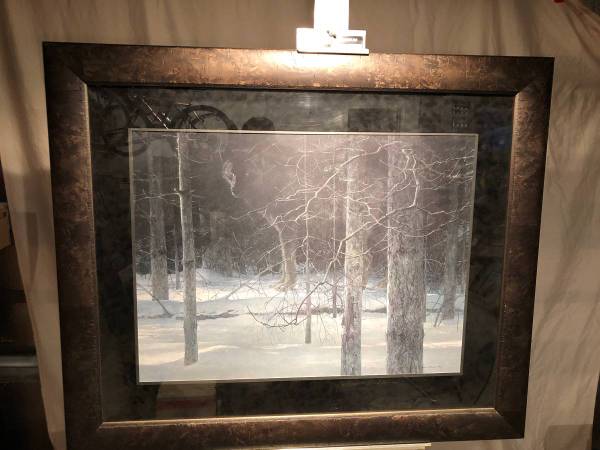
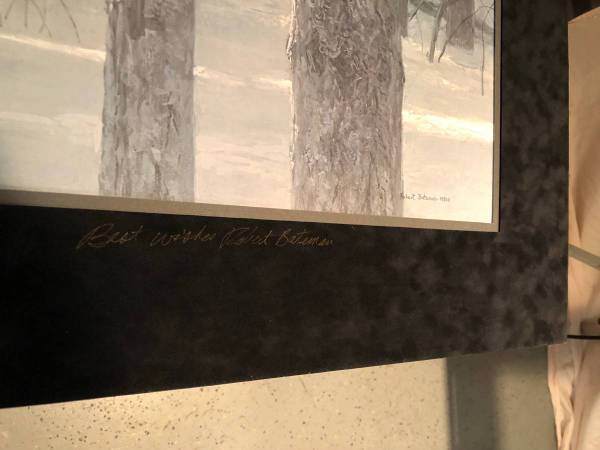
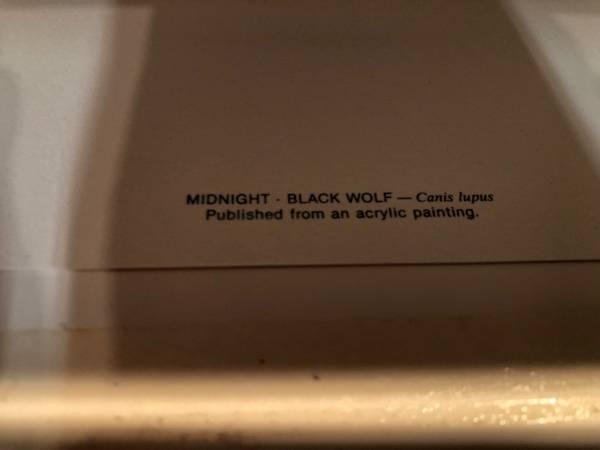
1) “Midnight - Black Wolf” ($1,750)
by acclaimed Canadian artist
Robert Bateman (Canadian, b.1930)
A framed, signed and numbered (#23,024/25,352) (sold out) lithograph print
Print measures 23” tall x 30.625” wide
Frame measures 36.75” tall x 44” wide
"In this painting I wanted to show the ominous presence of a mature, lone wolf, I wanted to create a mood of seriousness and respect - not threat. From the artistic point of view, I was intrigued by the challenge of portraying a black animal on an almost black background. It is something like playing a whole piano composition in half an octave of the bass section." Robert Bateman
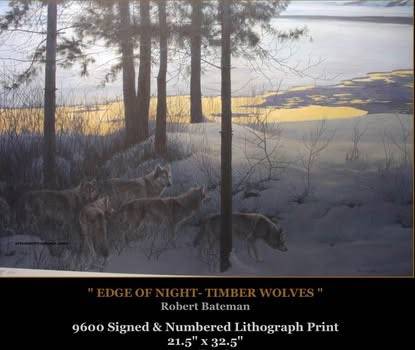
2) “Edge of Night-Timber Wolves” ($500)
by Robert Bateman (Canadian, b.1930)
A signed and numbered (#2101/9600)
lithograph print with original Mill Pond Press folio
Image measures 21.5” tall x 32.25” wide
Print measures 26.5” tall x 37.25” wide
“The last glow of winter sunlight fades, transforming the lake shore into a ribbon of gold. Silhouetted against the silent snow, a band of hunters emerges. It has been a variable winter. The snow has partially thawed and then frozen again. The light dusting of snow on top has made traveling easier for the wolves. However, the strong crust also makes it easier for the deer. The wolves can
hunt better with a crust strong enough to support their ample paws, but too weak to hold the weight of their sharp hooves. During a heavy winter, the deer tend to "yard-up" in a cedar grove with trails for easier access. There is such a yard nearby, but the deer are not there because at the present, they can move around on top of the snow. The wolf pack must get under way if they are to eat tonight. As dusk deepens, they move out of concealment
to the lake. The current along the near shore has opened up the water. In it, the last golden glow of the sky is reflected. Perhaps the deer are on the other shore. Perhaps they are not. The life of a wolf is, at best, uncertain." Robert Bateman
“Born in Toronto, Ontario, Canada in 1930, Robert Bateman was a keen artist and naturalist from his early days. Bateman painted wildlife and wilderness in a representational style until his teens when he began to interpret nature using a variety of contemporary styles including post-impressionism and abstract expressionism. In the early 60s, Bateman rediscovered realism and began to develop the style that would make him one of the foremost artists depicting the world of nature. In the 70s and early 80s, Bateman's work began to receive critical acclaim and to attract an enormous following.”